New Biography Revives Joseph Bell, the Surgeon Who Modeled Sherlock Holmes
Historian Lindsey Fitzharris details the diagnostic habits of the Edinburgh doctor who taught Arthur Conan Doyle, arguing that prior accounts lacked a proper medical perspective.
By Brian Foster ·
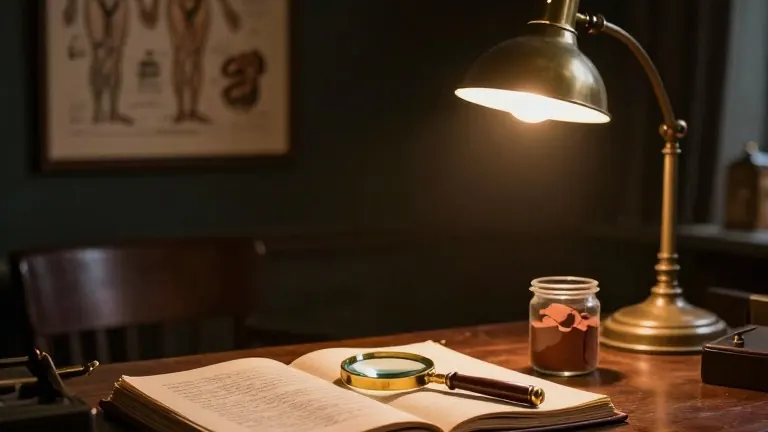
Medical historian Lindsey Fitzharris released a new biography of Joseph Bell, the Edinburgh surgeon who served as the primary model for Arthur Conan Doyle’s fictional detective Sherlock Holmes. The book, titled Sleuth-Hound: The Case of the Real Sherlock Holmes, focuses on the clinical methods Bell used to deduce patient histories and occupations from physical observations. Fitzharris aims to correct the historical record by applying a specific medical lens to Bell’s life, a perspective she argues was missing from previous major publications on the subject.
Bell worked at the University of Edinburgh, where he taught Conan Doyle during the author’s time as a medical student. He was known for his ability to infer a patient’s background and ailments simply by looking at them. One documented instance involved Bell identifying the route a patient had taken to the infirmary by analyzing the specific type of clay on the patient’s boots. Conan Doyle adapted this diagnostic clue into the plot of The Sign of Four.
The surgeon also functioned as a medical detective, collaborating with a local police surgeon on high-profile murder cases in his era. Fitzharris notes that while the Sherlock Holmes fan community has some familiarity with Bell through a 1982 book by Ely Liebow, a comprehensive commercial biography had not existed until now. She sought to bring the depth of medical history to the narrative rather than relying solely on literary connections.
This is not Fitzharris’s first foray into the history of Scottish surgery. She published The Butchering Art in 2017, a biography of Joseph Lister, a pioneer in antiseptic surgery. Her 2022 work, The Facemaker, profiled Harold Gillies, the surgeon who rebuilt the faces of World War I soldiers. In 2020, she hosted a Smithsonian Channel documentary series that used virtual autopsies and blood sample experiments to investigate famous deaths, including those of Pablo Escobar and Harry Houdini.
Fitzharris also collaborated with her husband, caricaturist Adrian Teal, on an illustrated children’s book called Dead Ends! Flukes, Flops, and Failures that Sparked Medical Marvels last year. Her new work returns to the Victorian Edinburgh setting of her earlier book, a city defined by body snatchers and the discovery of ether. She describes Bell as a figure who bridged the gap between clinical observation and the emerging science of forensic deduction.
In an interview, Fitzharris explained that she wanted to move beyond the limited scope of previous texts. She stated that she knew Bell was the inspiration for Holmes but felt the character’s medical roots required a more rigorous historical treatment. The book positions Bell not just as a muse for a writer, but as a central figure in the development of modern diagnostic medicine in Scotland.
Source: Ars Technica